Most tax surprises do not happen all at once. They build quietly throughout the year.
A raise. A bonus. A business that performed better than expected. A property that became a rental. An investment sale. A job change. A family transition. A Michigan lake house that is now being rented for part of the summer.
Each change may seem manageable on its own. But together, they can shift your tax picture in ways that are easy to miss until filing season. By then, your options may be more limited.
That is why a midyear tax checkup can be so helpful, especially for high-income families and business owners in Northwest Indiana. It gives you a chance to pause, review what has changed, gather the right information, and identify what may need attention before year-end.
For many local families, the picture may also stretch across state lines. You may live in Indiana, work in Illinois, own a lake house in Michigan, or have business and investment activity in more than one state. Those details can make proactive guidance even more important.
You do not need to know every tax rule before starting the process. The goal is simple: spot the changes that could affect your tax picture and decide whether a conversation with a tax advisor, financial advisor, or coordinated advisory team may be worthwhile.
Why a Midyear Tax Checkup Matters
Tax planning is easier when there is still time to make adjustments.
By midyear, you usually have enough information to see how the year is shaping up. You may know whether income is higher than expected, whether your business is on track, whether investment activity created gains, or whether a life event changed your financial situation.
A midyear tax checkup can help you answer practical questions:
Are your withholdings still accurate? Did anything happen this year that could increase your tax bill? Are you tracking the right records? Are there planning opportunities to consider before year-end? Would it make sense to include a financial advisor in the conversation?
For Northwest Indiana families, this can be especially useful when income, property, or work crosses state lines. Many local professionals and business owners have ties to Indiana, Illinois, and Michigan. Reviewing those moving parts now can help clarify whether your tax picture should be considered on its own or alongside your broader financial plan.
1. Has Your Income Changed?
Start with income. For high-income households, a meaningful shift in compensation can create a meaningful tax impact.
Maybe your household income increased or decreased by 20% or more. Maybe you received a raise, bonus, commission, or equity compensation. Maybe one spouse started or stopped working. Or maybe your withholding has not been updated, even though your income looks different than it did at the beginning of the year.
When income changes but tax payments do not, the result may be an unexpected bill later. A midyear tax checkup gives you time to look at withholding and whether your current plan still fits the year you are actually having.
Income changes may also create broader planning questions. If a raise, bonus, or new compensation structure gives you more cash flow than expected, it may be worth discussing how that money fits into your investment strategy, retirement plan, charitable giving goals, or other priorities.
2. Did You Sell Investments or Have Cash Sitting in Money Markets or CDs?
Investment decisions and tax planning are closely connected. When they are reviewed separately, important details can get missed.
If you sold $10,000 or more of stocks, mutual funds, real estate, or other appreciated assets this year, it may be worth reviewing the tax impact before year-end. The same is true if you have capital loss carryforwards from last year that may need to be considered.
This is also a good time to look at large cash positions. If you have more than $250,000 in money market funds or CDs, it may be worth discussing how that fits into your broader tax, income, and financial plan.
The goal is not to avoid every tax. The goal is to understand the impact early enough to make informed decisions. Midyear is a good time to see whether investment activity, interest income, or unused planning opportunities have changed your broader picture.
This is one area where including a financial advisor may make sense. Investment sales, cash positions, capital gains, and retirement income decisions often have both tax and financial planning implications.
3. Did You Start, Grow, Buy, or Sell a Business?
Business ownership can change your tax outlook quickly. Income, payroll, expenses, entity structure, and available cash flow all deserve attention during the year, not just after it ends.
If your business income is higher or lower than expected, your tax plan may need to be updated. The same is true if you added employees, changed payroll, took on new expenses, or are unsure whether your current entity structure still fits the business.
For many Northwest Indiana business owners, operations may touch both local and Chicagoland markets. That can add complexity, especially when income, payroll, and advisory decisions are handled in separate places.
Business changes can also raise financial planning questions. If the business has excess cash flow, it may be worth discussing whether that cash should stay in the business, be invested, be used for retirement planning, or support another goal.
A midyear tax checkup helps replace guesswork with a clearer view of where the year may be headed and whether your tax advisor, financial advisor, or both should be involved.
4. Did You Change Jobs, Retire, or Shift How You Are Paid?
A job change can affect more than your paycheck. It may also affect withholding, benefits, retirement contributions, stock compensation, and state tax considerations.
This is especially relevant if you changed jobs, received a signing bonus, severance, or stock compensation, retired or semi-retired, or had changes to your benefits, HSA, or retirement contributions.
It also matters if you live in Indiana but started working in Illinois or another state. Remote or hybrid work can change the conversation too. If where you work changed this year, it may be worth confirming whether your withholding and income reporting still make sense.
A career or compensation change can also affect your broader plan. Retirement contributions, stock compensation, severance, benefits, and rollover decisions often touch both tax planning and financial planning. A midyear tax checkup can help determine whether those pieces need to be reviewed together.
5. Did You Add Rental Income, a Lake House, or Other Real Estate Activity?
Real estate often creates tax questions that are easier to manage when records are current and decisions are reviewed early.
For Northwest Indiana families, real estate may extend beyond one local address. You may have your primary home in Indiana, rental property nearby, a lake house in Michigan, inherited family property, or a second home that is used personally and rented part of the year.
If you bought, sold, renovated, or converted a property to rental use this year, take time to gather the details. That includes rental income, expenses, property records, and any documentation connected to a second home, lake house, or vacation rental.
A lake house or vacation property can feel personal, but once rental income enters the picture, the tax details become more important. Personal use, rental use, state location, improvements, and recordkeeping can all matter.
Real estate can also affect your financial plan. A rental property, second home, or property across state lines may influence cash flow, insurance needs, estate planning, retirement goals, and investment decisions. A midyear tax checkup can help clarify whether the issue is mainly tax-related or whether a financial advisor should be part of the conversation.
6. Have You Had a Major Life Event?
Life changes can bring enough stress on their own. Tax uncertainty does not need to add to it.
Marriage, divorce, the birth or adoption of a child, a child starting college, the loss of a spouse or family member, significant medical expenses, an inheritance, or a large gift can all affect your tax picture.
These events often affect more than one part of your financial life. An inheritance may bring investment decisions. A divorce may require tax, cash flow, and estate planning updates. A child starting college may affect how you think about income, savings, and timing. A death in the family may raise questions about inherited assets, real estate, or future planning.
You may not know the exact tax impact yet, and that is okay. The purpose of a midyear tax checkup is to identify what changed, clarify what matters, and decide what steps may come next.
7. Are Charitable Giving and Retirement Planning Still on Track?
Charitable giving and retirement planning can both affect your tax picture, but timing matters.
If you plan to make charitable gifts totaling $25,000 or more this year, it may be helpful to coordinate that decision with income, investment gains, and broader financial planning.
For business owners, this is also a good time to look at excess cash flow. If the business is performing well and you have more cash available to invest, there may be planning conversations worth having before year-end.
Required minimum distributions may also need attention, depending on your age and retirement account situation. Waiting until filing season may limit what can still be done.
This is one of the clearest areas where a financial advisor may add value alongside a tax advisor. Giving strategies, retirement contributions, RMDs, investment gains, and business cash flow often overlap. Reviewing them together can help you avoid making decisions in isolation.
What a Midyear Tax Checkup Can Help Uncover
A midyear tax checkup can help you understand whether your current tax plan still fits the year you are actually having.
It may reveal that withholding needs to be adjusted. It may show that investment gains, business income, rental activity, or real estate decisions need closer review. It may also help confirm whether your records are complete and whether major life changes have tax implications.
Just as important, it can help identify when a financial advisor should be part of the conversation. Some questions are not purely tax questions. A large bonus, concentrated cash position, business growth, investment sale, charitable gift, retirement transition, or Michigan lake house rental may affect your tax situation and your broader financial plan.
For families with Indiana, Illinois, and Michigan ties, a midyear tax checkup can also help bring those details into one clearer picture. Your financial life may not fit neatly into one category or one state, and that is exactly why coordinated guidance can be valuable.
How to Use the Checklist on Your Own
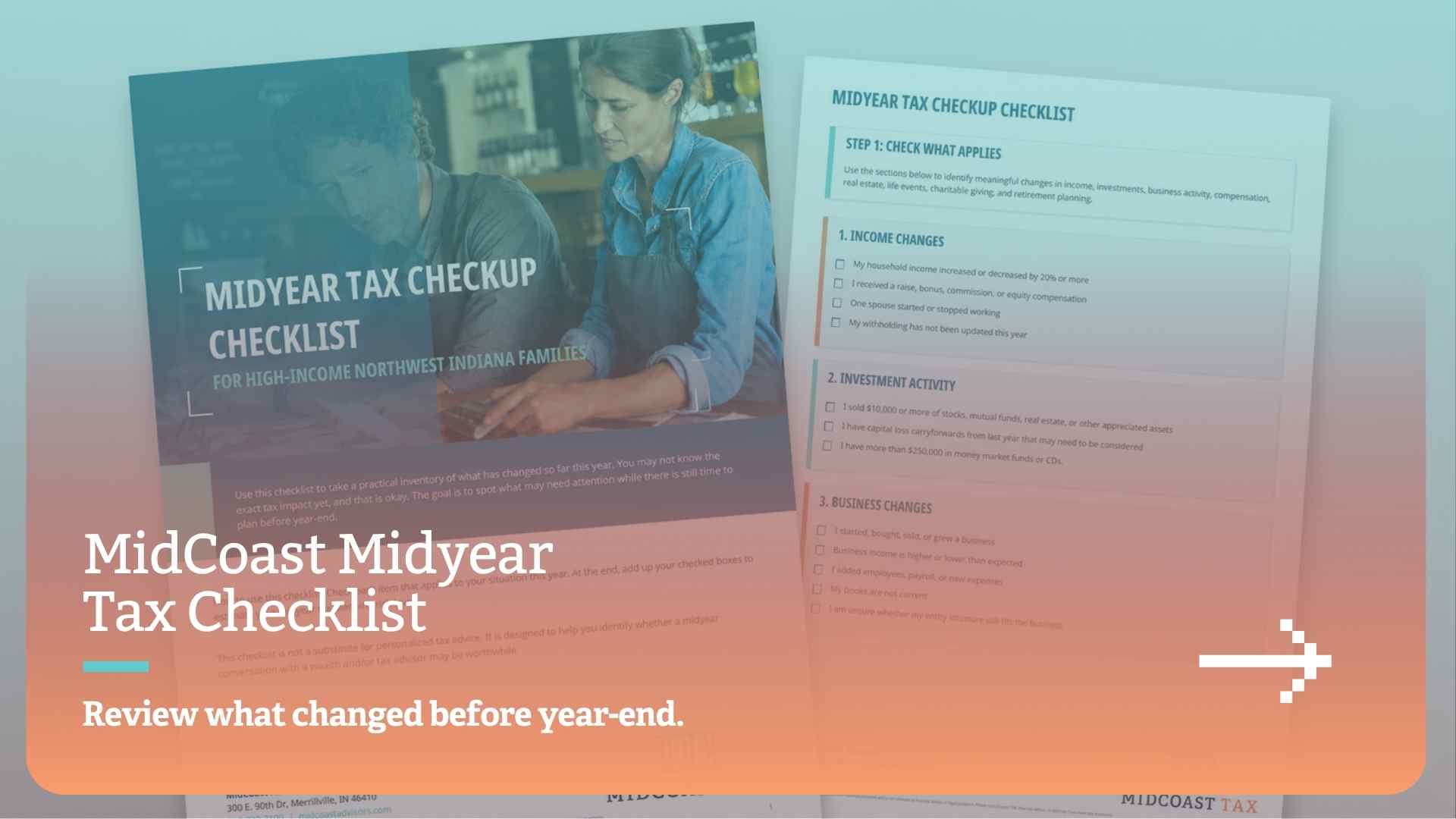
The companion checklist is designed to help you take a simple inventory before a conversation.
Set aside 30 minutes and move through each section. Ask yourself what changed this year, whether the amount was significant, whether your records are current, and whether you have already talked through the change with a tax professional.
Also ask whether the change could affect more than your tax return. Could it affect your investments, retirement plan, cash flow, charitable giving, estate planning, or broader financial strategy?
A few checked boxes may simply mean you should keep good records and continue monitoring your situation. Several checked boxes may suggest your financial life has changed enough to deserve a closer look. If you checked many boxes, your tax picture may have multiple moving parts that should be reviewed before year-end decisions become more limited.
Regardless of your total score, consider reaching out if you sold a business, property, or significant investment, or if you received a large bonus, severance, inheritance, or gift.
The checklist is not meant to help you solve every tax question by yourself. It is meant to help you spot what changed, gather the right information, and ask better questions before year-end.
Before Year-End, Take a Second Look
If your income, investments, business, real estate, or family situation has changed this year, your tax plan may need a second look.
That is especially true if your financial life crosses state lines. For many Northwest Indiana families, that may include Indiana residency, Illinois work or business income, Michigan lake property, rental activity, or property in more than one state.
A midyear tax checkup does not require you to have every answer. It simply helps you identify what changed, gather the right information, and understand whether your current approach still fits the year you are actually having.
From there, a discovery call can help determine whether tax planning, financial planning, or a coordinated conversation with both advisors may make sense before year-end.
Before year-end, ask yourself:
What changed this year, and have I talked through the tax and financial impact with someone who understands the full picture?
Ready to take inventory? Download the Midyear Tax Checkup Checklist or schedule a discovery call to talk through what has changed this year.